
Surfact “Hockey Puck” Tracker: Parts of the Logistics Business are Still in the Stone Age
September 17, 2026 | 3 min to read
“”
The Norwegian team behind the “hockey puck” tracker is back in the U.S. – and they are here with a warning. “Tech-wise, important parts of the logistics business are still in the stone age. We’re here to change that,” says Surfact co-founder.
The IFDA Solutions Conference was underway in San Antonio, Texas, in mid-September, bringing together leaders and decision-makers from the foodservice distribution industry.
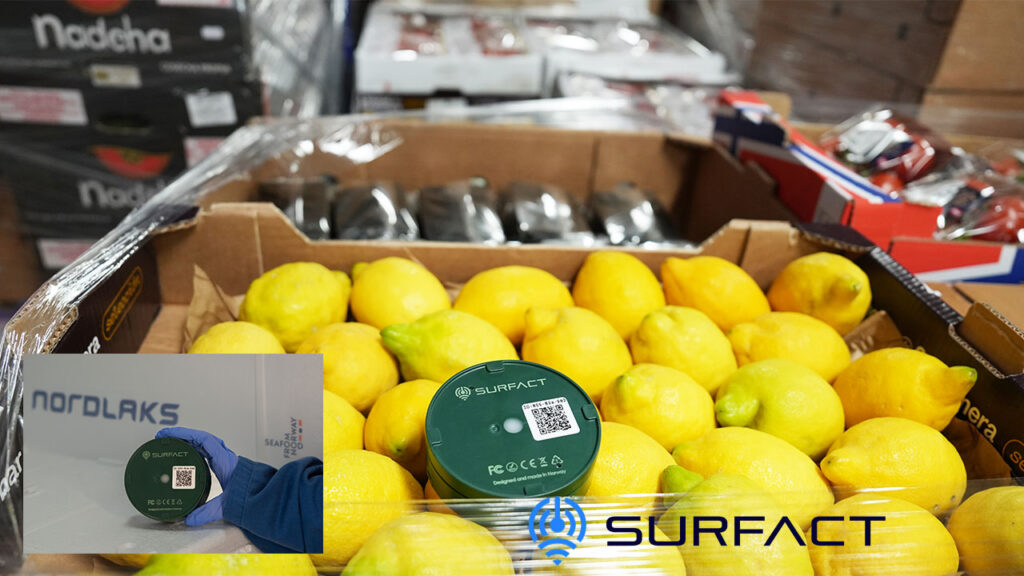
Attending this year, as last year, is Surfact, the Norwegian technology company behind Emma, an advanced but easy-to-use IoT sensor that monitors temperature, shock, light exposure and location in real time. The hockey puck-shaped device is now being used across large parts of Scandinavia’s food and pharmaceutical transport industries.
“When we started out, we were a bit shocked by how much critical logistics still relies on outdated systems and manual processes. Norway and Scandinavia are supposed to be at the cutting edge of technology, but we soon realized that certain routines in the logistics business are still in the stone age. And this isn’t just a Scandinavian problem. We see many of the same challenges here in the U.S.,” says Bjørnar Lie, CTO and co-founder of Surfact.
“It’s still pen and paper”
In the U.S. alone, Surfact estimates that more than 500,000 temperature-controlled trailers, trucks and delivery vehicles still operate without live temperature visibility. That means a significant part of the cold chain is moving food and other temperature-sensitive products every day without continuously knowing what is happening to the cargo.
“It’s still pen and paper and sporadic manual registration, when all of this could be done automatically and digitally without any hassle.”
“When the paper reports are finally in, the food may already be ruined, and you have little idea what caused the damage. Our sensor follows the cargo from farm to fork, putting the spotlight on all the blind spots along the way. Our experience is that this data can sometimes be uncomfortable, because it exposes problems that have previously been invisible. But it’s only when we see the problem that it can be fixed,” says Lie.
Enormous waste – and a reputation at risk
In supply chains dealing with sensitive products such as perishable foods and medicines, even a minor mistake can lead to major losses. Around 20% of medicines are damaged due to cold-chain failures*, while food waste is even worse. One-third of all food produced for human consumption is lost or wasted, often because of temperature problems, and food waste is costing the world’s economy around $1 trillion each year.**
And the cost goes beyond the wasted products. It can also lead to serious reputational damage. Major food brands have seen how food-safety outbreaks can quickly affect both customer trust and company value.
“Food safety is not just about avoiding waste. Once your brand becomes associated with unsafe food, even if the fault lies with a third-party supplier somewhere in the chain, customer trust can disappear quickly. The consequences can hit the brand, the bottom line – and ultimately the value of the company,” says Lie.
Surfact’s “hockey puck,” Emma, was launched on the U.S. market in 2025 and is now in use across 20 countries and markets, including Germany, the UK, Scandinavia, Dubai and Canada.
About Surfact and Emma:
- Surfact was founded in 2021 by Per Magne Helseth, Bjørnar Lie, and Alf E. Helseth.
- The idea for the technology emerged when founder Per Magne Helseth served in the Norwegian forces in Afghanistan, witnessing valuable cargo like food and medicine ruined in the intense heat.
- The Emma sensor was developed in 2023 and launched commercially on the global market in 2025.
- Emma is made from recycled ocean plastic, has a battery life of two years, and is built to withstand harsh conditions.