
Students create ornamental grass display garden at Oregon State Farm
July 14, 2026 | 6 min to read
CORVALLIS, Ore. — A student planted ornamental grass display garden at Oregon State University (OSU) offers a nod to Oregon’s nursery and landscape industries by showcasing plants that can be used in designed landscapes.
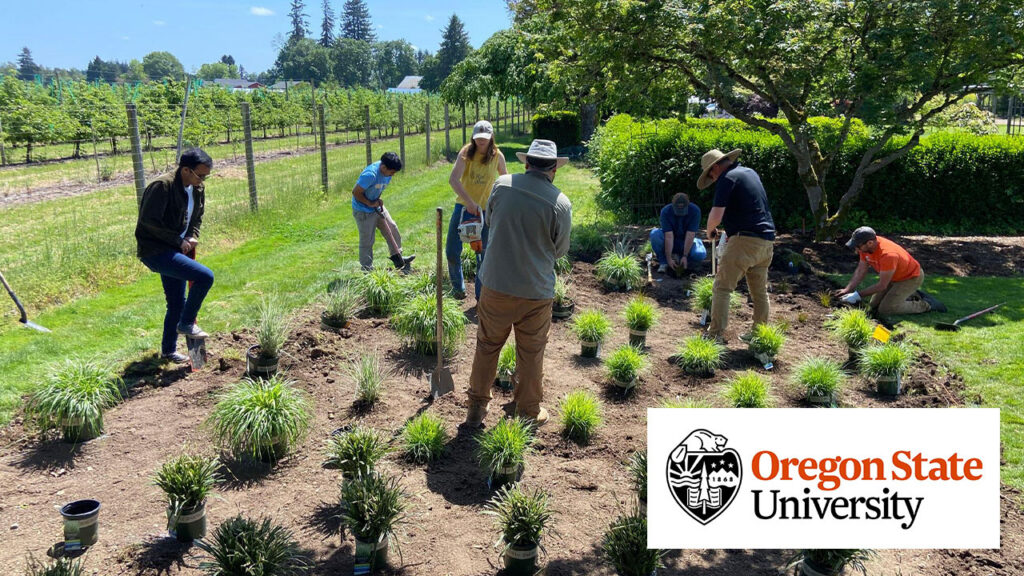
On a sunny May afternoon at OSU’s Lewis-Brown Farm, a group of mostly students worked in a corner of the farm with shovels, augers and rows of potted ornamental grasses.
“It’s nice to have motivated students who can have this kind of free thinking and come up with ideas like this and execute on them.”
Under a large Norway maple, Sadie Duffy dug a narrow trench for plastic edging that would help keep turfgrass out of the new planting. Nearby, Mary Davidson dug holes in the soil. Around them, students moved across the bed, planting grasses selected for their height, color, texture and late-summer blooms.
The work marked the installation of a student-led ornamental grass display garden at Lewis-Brown Farm, which supports field research and projects in the Department of Horticulture in the College of Agricultural Sciences.
Duffy and Davidson, recent OSU graduates and future graduate students, planned the project, which was advised by Chas Schmid, assistant professor and Giustina Endowed Turfgrass Specialist, whose appointment connects the work to OSU Extension Service outreach.
The garden will support teaching, field days and engagement with the public while highlighting ornamental grasses as part of landscape horticulture.
“It’s been a good way to get Sadie and Mary comfortable with all the equipment at the farm and give them a place of their own that they can put their stamp on,” Schmid said.
An idea takes root
The idea began after Duffy, who graduated in March with a bachelor’s degree in horticulture and a focus in turf and landscape management, traveled to Michigan State University for the National Collegiate Landscape Competition. While there, she saw photos and examples from a former ornamental grass garden at Michigan State’s turf facility.
When she returned to Corvallis, she brought the idea to Davidson and Schmid.
“We all really liked the idea of just doing grasses, especially because they are really good accents to a landscape,” Duffy said. “It’s not very common that you see them all planted at once, so we wanted to be able to look at the different varieties all together.”
Schmid had already been looking for a way to renovate the area. The site had been used for teaching years earlier but had become overgrown. Some older landscape plants were declining, and the space needed a new purpose.
He gave Duffy and Davidson room to design the garden, then helped connect them with plant and industry contacts. Ryan Contreras, a professor in the Department of Horticulture, connected the project with Monrovia. Josh Cady, a graduate of the OSU turf program who works with Oregon-based Monrovia Nursery Co., helped arrange the donation of most of the grasses.
Duffy and Davidson reviewed the Monrovia catalog, selected plants and planned the layout. Schmid said the project moved quickly, from early conversations in March to planning in April and plant pickup from Monrovia the week of installation.
Students blend design and field skills
The garden gave the students a chance to apply different skills to a shared project.
Duffy brought hands-on experience in turf and landscape management. Davidson, who also graduated in March, earned a degree in agricultural sciences with a focus in breeding and a minor in crop science. Both plan to enter graduate school in the turf program.
Their planning included decisions about height, color, spacing and how the grasses would look as the planting matured. Taller grasses were placed toward the back of the bed. Shorter grasses were placed toward the front. The students also considered how foliage color and bloom shape would work together across the display.
“It worked really well because I have more of an artistic eye when it comes to the colors,” Davidson said. “I’d pick one out, and Sadie would say, ‘That one’s about 6 feet tall, so we probably shouldn’t put it in the front.’ I feel like we complemented each other really well throughout the whole process.”
Unlike turfgrass used for lawns, athletic fields and other surfaces, ornamental grasses are planted for visual effect. Their value often comes from the shape of the plant, the color of the foliage and the blooms that appear later in the growing season.
“They function a lot more like an accent,” Duffy said. “They come in a lot of different colors, and their blooms are actually what’s most interesting about a lot of them.”
The timing was intentional. The grasses are expected to reach their peak in late summer, around the time of the farm’s turf field day, when visitors come to see projects and demonstrations.
A garden for teaching and outreach
The display garden’s value is in teaching, demonstration and outreach.
Schmid said the garden will be included as a tour stop during the turf field day. The site also will include drip irrigation, mulch and signs identifying the different grasses, giving visitors a chance to compare species and varieties.
Dan Blanchard, who teaches ornamental plant identification in the Department of Horticulture, also plans to use the garden as a teaching resource.
For Extension, the garden adds another public-facing feature at a farm that already supports horticulture research and education. It also offers a nod to Oregon’s nursery and landscape industries by showcasing plants that can be used in designed landscapes.
Schmid said the site should work well even with shade from the large tree above the planting. Some ornamental grasses can tolerate less than full sun, depending on the species. The team also planned to raise the tree canopy to allow more light into the bed.
“Everything’s kind of filled in and designed so that it’ll all come together into a sea of grass eventually,” Schmid said.
A visible mark at the farm
By planting day, the design had moved from a conference idea to a working garden. Students carried pots, dug holes, set plants and shaped the bed. Duffy kept working on the barrier edge. Davidson and others placed grasses into the soil.
For Duffy and Davidson, the project was a chance to make a visible contribution to the farm before beginning graduate school. It also gave them a way to blend turfgrass, landscape design and public education in a space that students, visitors and industry audiences will be able to use.
Schmid said that student ownership was the point. Much of the work at Lewis-Brown Farm is student driven, and the ornamental grass display garden gives another group of students a project that will remain after they move into the next stage of their careers.
“It’s nice to have motivated students who can have this kind of free thinking and come up with ideas like this and execute on them,” Schmid said. “I’m incredibly happy.”