
A Remarkable Comeback for Michigan’s Ancient Lake Sturgeon
November 17, 2026 | 5 min to read
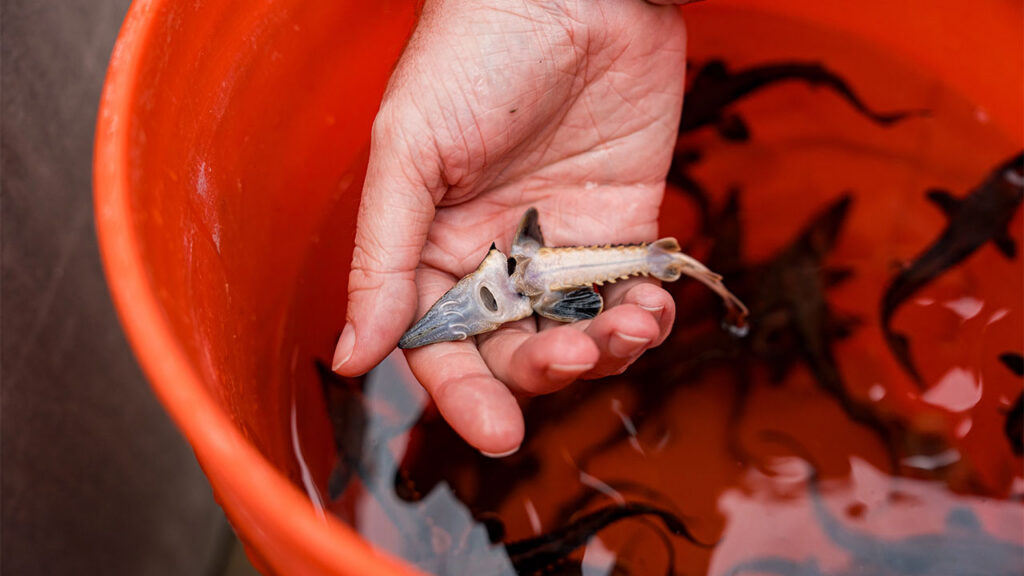
On a September morning at Hubbard Lake in northern Michigan, about 600 young lake sturgeon were about to enter a world no sturgeon had occupied before.
They were only about 5 inches long and four months old, small enough to carry to the water in buckets. But they were already built for survival.
Rows of sharp plates called scutes cover their backs and sides like armor, protecting them from predators. Four whisker-like barbels dangled beneath their snouts, helping them find food along the bottom. Some were nearly black, others surprisingly pale, their mottled bodies camouflaged against sand and silt.
If all went well, some of them could still be swimming in the lake centuries from now.
The release was a first for Hubbard Lake and part of a growing effort to restore lake sturgeon across Michigan. For Scott Colborne, an assistant professor in Michigan State University’s Department of Fisheries and Wildlife, watching the young fish disappear into the water was the culmination of months of work.
“Our team puts in so much work day in and day out,” Colborne said. “And then to have the sturgeon reach this point where they go out and start the rest of their life, it’s just really fulfilling and exciting to see.”
But the story that made releases like this possible began 25 years earlier, about 40 miles north, when the future of another lake sturgeon population looked considerably less hopeful.
A population in trouble
Ed Baker, Michigan Department of Natural Resources fisheries biologist who developed the lake sturgeon research program.
Lake sturgeon have inhabited the Great Lakes region since long before humans arrived. Their lineage stretches back roughly 130 million years, surviving enormous environmental change along the way. Humans proved to be a different kind of challenge.
Overharvest, dams and habitat changes devastated lake sturgeon populations across their historic range. By the 1990s, Michigan Department of Natural Resources fisheries biologist Ed Baker had reason to worry about the population in Black Lake.
Baker had been hired in 1995 and charged with developing a lake sturgeon research program. Two years later, his team conducted a three-week survey to compare the lake’s adult population with an estimate from the 1970s.
What they found stunned them.
“To our shock and dismay, we discovered that the adult abundance in the lake had declined over that 20-year period by about 66%,” Baker said.
Too few young fish appeared to be surviving to replace the adults disappearing from the lake. Legal harvest couldn’t account for all the missing fish, either, pointing to illegal harvest as another significant source of loss.
The population had reached a point where managers feared it could no longer sustain itself. Michigan tightened the Black Lake sturgeon harvest in 2000, moving from a system that allowed anyone with a fishing license to take one sturgeon to a tightly controlled lake-wide quota. Fisheries managers, researchers and local advocates also began building what would become the Black River lake sturgeon restoration program.
The effort began with the Michigan DNR and Central Michigan University. MSU joined the collaboration in 2003 bringing research expertise that helped scientists learn not just how to put more fish into Black Lake, but how to rebuild a genetically diverse population capable of eventually sustaining itself.
This year, MSU’s Black River Lake Sturgeon Hatchery and Research Center is celebrating 25 years of conservation, research and education.
Conservation on sturgeon time
Male lake sturgeon can take about 15 years to reach reproductive maturity. Females can take roughly 25. And they don’t necessarily spawn every year.
That creates an extraordinary problem for anyone trying to determine whether a restoration program actually works.
Scientists can raise a young sturgeon, tag it, release it — and have to wait decades to learn whether that fish survived, matured, found its way back to the river and reproduced.
Over the years, the signs began accumulating.
Researchers found the first young sturgeon in Black Lake. Then hatchery-raised males began returning to the Black River as adults in 2018. At first, researchers saw only one or two. Now, Colborne said, they typically see 10 to 20 hatchery-raised males return in a year.
Then, in 2025, came a milestone they had waited nearly a quarter century to see: The first female raised through the hatchery program returned to the Black River to spawn. She was about 24 years old.
“We’ve been at it for 25 years and I know that seems like a long time,” Colborne said. “But, you know, getting that first female back — we now have fish that have come from this hatchery, male and female, that could theoretically reproduce together. Now you’re talking about the next generation of surviving lake sturgeon.”
The adult population has more than doubled from its late-1990s low, and fish released as young juveniles near the beginning of the program are now returning as adults to spawn.
The next generation of Black Lake sturgeon may increasingly come not from the hatchery, but from the fish the hatchery helped save.
Raising fish to come home
Getting a sturgeon from its earliest days to that 5-inch release size is where much of the work happens.
Doug Larson, an MSU research assistant who has spent 11 years working with the project and about 15 years in fish hatcheries, knows how precarious those first weeks can be.
The process begins each spring when adult lake sturgeon return from Black Lake to spawn in the Black River. Rather than relying solely on eggs produced in a hatchery, the program primarily raises young produced naturally in the river.
After hatching, tiny sturgeon hide in rock crevices on the river bottom and live off their yolk sacs. Depending on water temperature, they may remain hidden for three to 10 days.