
Seafood Industry Calls for Reform of EU CATCH System
September 30, 2026 | 5 min to read
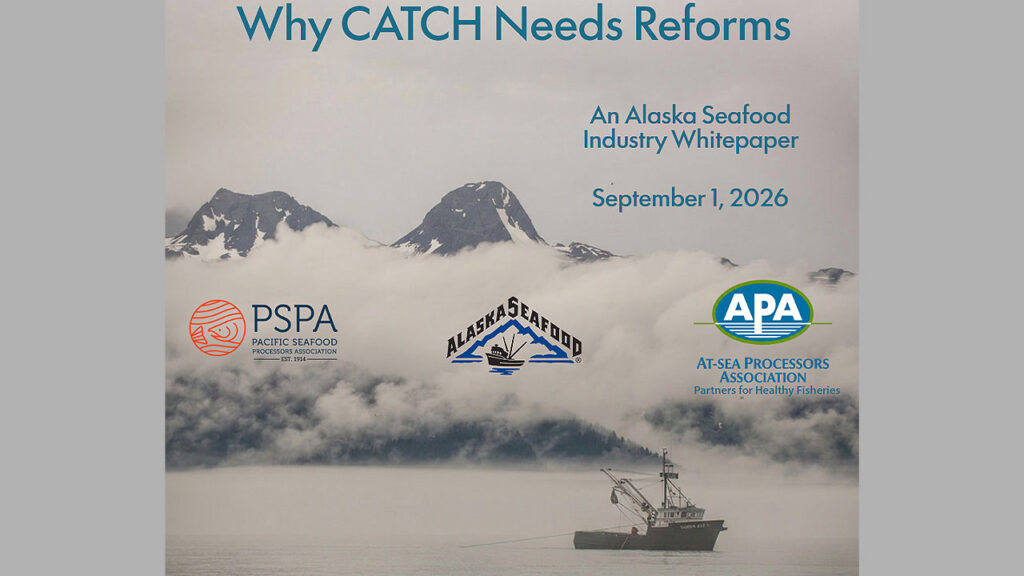
Seafood Industry Organizations Call for Reforms to EU CATCH Traceability System
ANCHORAGE, Alaska — Four leading seafood industry organizations representing harvesters, processors, marketers and seafood businesses in the United States are calling for reforms to the European Union’s CATCH digital seafood traceability system, saying the system’s current requirements are creating unnecessary barriers for legally harvested seafood while failing to adequately account for the realities of complex seafood supply chains.
The Pacific Seafood Processors Association (PSPA), Alaska Seafood Marketing Institute (ASMI) and At-sea Processors Association (APA) released a new whitepaper, Advancing EU Efforts to Combat IUU Fishing: Why CATCH Needs Reforms, outlining concerns with the system and recommending practical changes. Today, the U.S.’s National Seafood Association joins these organizations in calling for reforms to CATCH.
The organizations strongly support the EU’s efforts to combat illegal, unreported and unregulated (IUU) fishing.
“We share the European Union’s goal of preventing IUU fishing and ensuring that seafood entering the European market is legally harvested. But CATCH needs to reflect how seafood is actually harvested, processed and marketed,” said Julie Decker, president of the Pacific Seafood Processors Association. “We want CATCH to succeed, but the current system is imposing enormous costs on legitimate businesses without meaningfully improving the ability to identify IUU product.”
Real-World Disruptions
The whitepaper documents significant disruptions already associated with CATCH implementation. In one case, approximately 16,000 metric tons of Alaska seafood were affected by documentation issues involving two shipments through the Netherlands. The delays generated hundreds of thousands of dollars in direct costs for an Alaska logistics company, along with additional costs for participating U.S. seafood companies.
A separate case in Denmark resulted in approximately 600 metric tons of U.S. seafood being held amid conflicting guidance concerning CATCH documentation.
“These are not theoretical concerns,” said Jeremy Woodrow, executive director of the Alaska Seafood Marketing Institute. “When thousands of tons of legally harvested seafood are sitting in storage and businesses face significant additional costs, it is clear that implementation needs to be improved. The EU must establish a better system that protects the integrity of the seafood supply chain without unnecessarily restricting lawful seafood trade.”
Industry Calls for Practical Reforms
The organizations recommend several changes to make CATCH more effective and workable:
- Use a risk-based approach that recognizes countries and fisheries with strong domestic licensing, monitoring, catch accounting and enforcement systems.
- Allow aggregation at commercially meaningful points, such as processing facilities, rather than requiring impractical vessel-by-vessel tracking through complex production chains.
- Revise unreliable mass-balance and processing-statement requirements that do not accurately reflect the relationship between harvested catch and finished seafood products.
- Improve system interoperability, including bulk uploads, standardized data formats and automated data exchange.
- Extend the implementation timeline to allow U.S. and EU authorities, industry and importers to conduct transparent, fishery-specific testing and develop workable solutions.
“The Alaska seafood industry has invested heavily in monitoring, enforcement and responsible fisheries management. CATCH should recognize those systems rather than create unnecessary duplication,” said Matt Tinning, CEO of the At-sea Processors Association. “The objective should be better detection of illegal seafood, not simply more paperwork for legal seafood.”
“IUU product has no place in the seafood supply chain. American companies are proud of our dedication to this principle. The current EU CATCH system punishes years of efforts to curtail seafood harvested outside of this commitment,” said Lisa Wallenda Picard of the National Seafood Association.
The concerns are shared by European seafood businesses that depend on reliable international supply chains.
“European seafood businesses fully support the fight against IUU fishing, but CATCH must be workable in practice,” said Katarina Sipic, secretary general of Seafood Europe. “When legitimate seafood is delayed or held because documentation requirements do not reflect how modern fisheries operate, the consequences are felt by European businesses and consumers as well as international suppliers.”
The recommendations detailed in the whitepaper strengthen, not weaken, the EU’s efforts to combat IUU fishing. They call for continued collaboration between U.S. and EU authorities, industry and other trading partners to develop a system that improves traceability while maintaining efficient access to legally harvested seafood.
“This is ultimately about getting the system right,” said Decker. “We want to work with the European Commission, Member States and U.S. agencies to build a CATCH system that actually helps identify IUU seafood while allowing legitimate seafood to move efficiently through international markets.”
Advancing EU Efforts to Combat IUU Fishing: Why CATCH Needs Reforms — An Alaska Seafood Industry Whitepaper details documented examples of CATCH-related disruptions and the organizations’ specific recommendations for reform.
The whitepaper may be found online at alaskaseafood.org/news/eu-catch.
About the Organizations
Alaska Seafood Marketing Institute (ASMI) is Alaska’s official seafood marketing organization, promoting Alaska seafood and supporting the long-term health and value of the state’s seafood industry.
At-sea Processors Association (APA) represents companies engaged in at-sea processing of Alaska seafood and advocates for responsible fisheries management and a sustainable seafood industry.
National Seafood Association is the U.S.’s national trade organization that supports sound public policy and nutrition information based on science on behalf of the seafood industry domestically and globally.
Pacific Seafood Processors Association (PSPA) represents Alaska seafood processing companies and advocates for policies that support a sustainable and economically viable Alaska seafood industry.
Seafood Europe represents the interests of European seafood businesses and promotes a competitive, sustainable and well-functioning seafood sector.