
Coalition for Fisheries Transparency and Partners Welcome The UK’s Ratification of IMO Cape Town Agreement
May 21, 2026 | 5 min to read
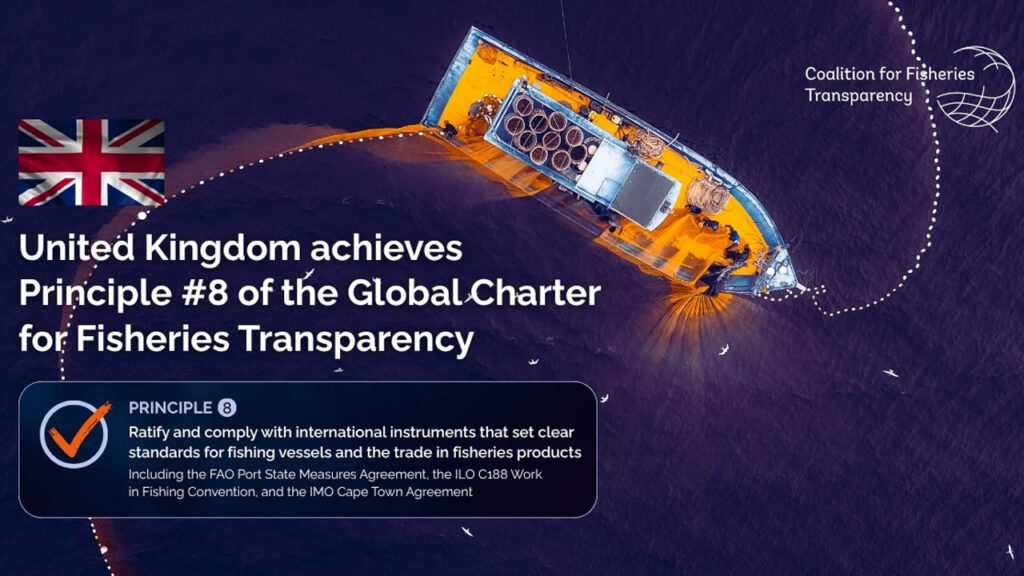
London – The Coalition for Fisheries Transparency (CFT) welcomes the UK’s ratification of the International Maritime Organization (IMO) Cape Town Agreement, a major ocean treaty which will protect fisher safety at sea, advance fisheries transparency and help deter illegal, unreported and unregulated (IUU) fishing. The UK is demonstrating its leadership by achieving Principle 8 of the Global Charter for Fisheries Transparency.
The UK has become the first State to ratify the IMO Cape Town Agreement since its full ratification in February 2026. This international treaty establishes global minimum safety standards for large commercial fishing vessels (24 m and above) that can operate on the high seas. These cover key parameters such as vessel stability and seaworthiness, fire safety, life-saving appliances, emergency procedures and radiocommunications.
The UK’s ratification comes just a few days after the National Fishing Remembrance Day 2026, held last Sunday. This day of commemoration reminds us that fishing has long been deemed one of the most dangerous professions in the world by the United Nations. It is estimated that more than 100,000 fishers die in the global fishing sector annually.[1]
Vivien Deloge, UK Coordinator of the Coalition for Fisheries Transparency, said “The UK has now ratified all three treaties aiming to fight IUU fishing; by doing so, it has successfully achieved Principle 8 of the Global Charter for Fisheries Transparency on the international IUU treaty framework, and positions itself as a clear international leader promoting safe, legal and sustainable fishing. I commend the UK for its ratification as an act of international solidarity, highlighting the need for global minimum safety standards for the benefits of all fishers worldwide.”
The Global Charter for Fisheries Transparency is a set of ten easy-to-implement principles aiming to address the lack of transparency in three critical areas: vessel information, fishing activity, and fisheries governance and management. The UK has been a supporter of the Global Charter since October 2024.
Ambassador Peter Thomson, UN Secretary-General’s Special Envoy for the Ocean, said “The UK’s ratification of the IMO Cape Town Agreement demonstrates the international momentum for ocean action in general, and fisher safety at sea in particular. I invite all IMO States to build on this momentum and ratify the Cape Town Agreement to increase fisheries transparency and support the fight against IUU fishing, as outlined in Sustainable Development Goal 14.4.” (tbc)
Lord Robin Teverson, member of the All-Party Parliamentary Group (APPG) on Fisheries and APPG for the Ocean, said “Safety at sea should never be taken for granted, and the UK’s ratification is a strong signal that the lives of every fisher worldwide matter. Ratification of the Cape Town Agreement is a key component of the IUU Fishing Action Alliance that the UK co-founded in 2022, and the UK is the only founding member to have delivered on this commitment.”
Chris Williams, Fisheries Section Coordinator at the International Transport Workers’ Federation (ITF), said “For too long, fishing has remained one of the world’s most dangerous industries, with too many fishers paying the price for weak safety standards and poor oversight. The UK’s ratification of the Cape Town Agreement is a significant step towards ensuring that every fisher, regardless of where they work, is protected by international safety standards. Stronger regulation and transparency at sea are essential not only to safeguard lives, but also to tackling illegal fishing and promoting decent work across the global fishing industry.”
Olivia Swift, Head of Maritime Systems at the Lloyd’s Register Foundation, said “Fishing is a vital industry, but it remains far too dangerous. The Cape Town Agreement sets out practical, lifesaving standards that protect fishers and shine a light on vessels operating on the high seas. The UK’s ratification is an important step towards a safer, more transparent global fishing system.”
With the UK’s ratification, the Cape Town Agreement now includes 29 Parties with 3,859 fishing vessels. It will enter into force in February 2027. The Agreement will enhance transparency by allowing parties to inspect foreign-flagged fishing vessels, even if their flag State has not ratified the treaty.
The Coalition for Fisheries Transparency is a global network of more than sixty global civil society organisations that work together to improve transparency and accountability in fisheries governance and management.
ClientEarth, the Environmental Justice Foundation (EJF) and Open Seas are leading the Coalition’s efforts in the United Kingdom to accelerate the adoption of the Principles of the Global Charter for Fisheries Transparency. Their work aims to help the UK champion effective fisheries governance globally to strengthen the fight against illegal, unreported and unregulated (IUU) fishing.
Ambassador Peter Thomson is the United Nations Secretary-General’s Special Envoy for the Ocean. He was appointed by the Secretary-General in 2017 to lead efforts to achieve Sustainable Development Goal 14. His appointment followed on from Fiji and Sweden’s co-hosting of the first UN Ocean Conference, which held earlier that year, and he has since been at the heart of maintaining momentum for action to conserve and sustainably use the ocean’s resources for sustainable development. He was closely involved in the organisation of the second and third UN Ocean Conferences and is currently working on the fourth to be held in the Republic of Korea in 2028.
The Lloyd’s Register Foundation is an independent global safety charity that supports research, innovation, and education to make the world a safer place. Its mission is to use the best evidence and insight to help the global community focus on tackling the world’s most pressing safety and risk challenges. The Lloyd’s Register Foundation recently commissioned a film, ‘All That Separate Us is Distance’, highlighting safety issues faced by small-scale fishers.
The International Transport Workers’ Federation (ITF) is a democratic, affiliate-led federation recognised as the world’s leading transport authority. We fight passionately to improve workers’ lives, connecting more than 760 affiliated trade unions from over 150 countries to secure rights, equality and justice for workers globally. We are the voice for more than 16.6 million transport workers across the world. ITF is a member organisation of the Coalition for Fisheries Transparency.
[1] Link for your information: The Pew Charitable Trusts, ‘More Than 100,000 People Die Annually Across Global Fishing Sector, New Research Shows’, 3 November 2022.