
Freshness Protection Tech Adds Five Days of Table Grape Marketable Life
November 6, 2026 | 3 min to read
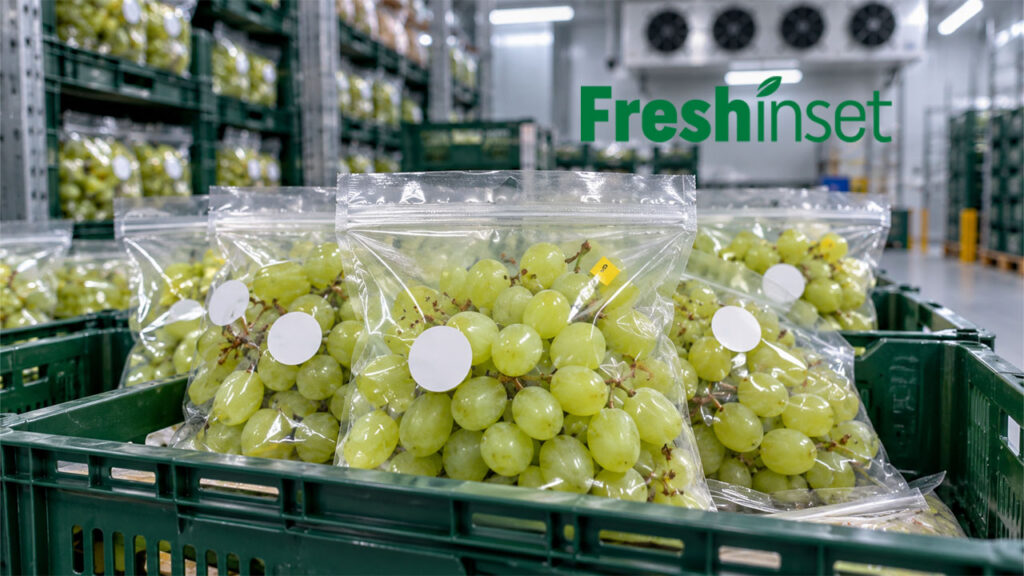
New analysis of nine post-harvest trials across Europe shows Vidre+ technology extends table grape marketable life by approximately 35%, with improvements in stem appearance, berry integrity and decay-related quality.
For the international table grape industry, maintaining freshness from vineyard to supermarket shelf remains one of the most persistent post-harvest challenges. Grapes often travel thousands of miles, spending weeks in cold storage, refrigerated transport and distribution before reaching consumers.
Even under carefully managed conditions, quality deterioration can reduce commercial value. Browning stems, berry damage, fruit detachment and fungal decay can all affect consumer acceptance, resulting in rejected shipments, retail markdowns and food waste.
Fresh Inset’s Vidre+ is a freshness protection technology that expands the possibilities for 1-MCP application, including in areas where conventional post-harvest treatment methods have been difficult or impractical to implement. Designed for integration across fresh produce supply chains, from grower operations and packinghouses to retail packaging, Vidre+ offers a flexible, user-friendly approach to ethylene management across a wide range of crops. Unlike traditional 1-MCP application methods, which often require specialized infrastructure or controlled treatment environments, Vidre+ can be incorporated directly into existing packaging formats as a sticker, label or imprint.
Now, a newly published analysis by Fresh Inset suggests that its Vidre+® freshness technology could help address these challenges. According to the company’s latest table grape case study, Vidre+ stickers extended the marketable life of grapes by an average of 4.95 days, equivalent to approximately 35% longer marketable life, compared with control sample.
The findings are based on nine post-harvest trials conducted in Italy, Greece, Spain and the United Kingdom, involving 38 Vidre+ sticker variants and 354 paired quality comparisons.
What five additional days could mean for growers, packers and retailers.
For packing houses, improved berry integrity and delayed stem browning could support quality preservation during handling, storage and distribution. The technology may also create opportunities to maintain commercial quality for longer without fundamentally changing the product’s presentation.
For retailers, the potential benefits are closely linked to product appearance, shelf availability and inventory management. Grapes are a highly visual fresh produce category, and shoppers frequently assess freshness through stem colour, berry firmness and overall bunch condition. Maintaining these attributes for longer could help retailers offer more consistent quality while potentially reducing product rejection and waste.
For the wider industry, the findings also connect with growing efforts to reduce food losses and improve resource efficiency throughout fresh produce supply chains. Extending marketable life does not automatically guarantee lower food waste, but it can create additional opportunities to sell fruit before quality deteriorates beyond commercial acceptance.
The results point to potential benefits for the international fresh produce supply chain, where even a relatively small extension in marketable life can provide valuable additional time for transportation, distribution and retail sales.
For retailers, maintaining greener stems for longer could help preserve shelf appeal and reduce the need for premature markdowns.
The strongest calculated improvement concerned berry shatter and damaged berries.
Vidre+ stickers extended the time to an equivalent level of deterioration for this parameter by an average of 10.5 days, representing a 65% improvement over control samples.
Berry shatter, the detachment of individual grapes from the bunch, is particularly problematic during handling, transportation and retail display. Loose or damaged berries can undermine the visual quality of an entire package, making this result especially relevant for packers and retailers handling grapes through complex distribution networks.
Although the trials were conducted in Europe, their findings could be relevant to grape-producing and exporting regions worldwide. Major exporting countries such as Peru, Chile, South Africa and India face similar challenges in delivering attractive, high-quality grapes to distant markets. For these industries, technologies capable of extending the commercial quality window could potentially offer greater flexibility in export logistics.
The Fresh Inset analysis examined several of the most commercially important quality parameters for table grapes, including rachis browning, fungal decay, berry shatter and physical damage. The results indicate improvements across all three major quality categories assessed.
Green, healthy-looking stems are among the most visible indicators of grape freshness. Even when berries remain edible, brown or dried stems can negatively influence shoppers’ perceptions of quality. Across the trials, Vidre+ delayed the development of an equivalent level of rachis browning by an average of 5.6 days compared with control sample.