
Aquaculture Stewardship Council (ASC) Farm Standard Aligns Strongly With CARE Salmon’s Animal Welfare Vision
September 16, 2025 | 8 min to read
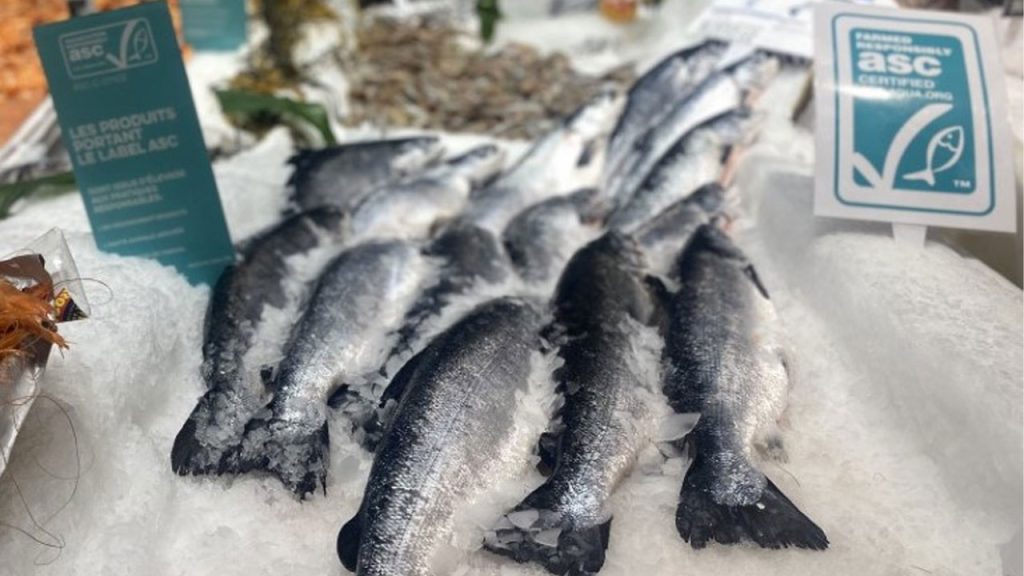
Aquaculture Stewardship Council (ASC) welcomes the call from the CARE Salmon collective—representing nearly 20% of French salmon imports and nearly half of its retail market share —for higher animal welfare standards. With the launch of the Farm Standard in May 2025, ASC is proud to demonstrate that these expectations are already being met, reaffirming its leadership in promoting responsible aquaculture and ensuring the highest standards of animal welfare.
The CARE Salmon Collective has issued an open letter urging Norwegian salmon farmers to raise animal welfare standards. Launched in June 2024 by Labeyrie Fine Foods in collaboration with Compassion in World Farming (CIWF) and consultancy Bureau Bankiva, the Collective unites major retailers and food service leaders—including Labeyrie Fine Foods, Groupement Mousquetaires, Auchan Retail, Api Restauration, Réseau Vivalya, E.Leclerc, Demarne, and HANA Group—to push for more responsible animal welfare practices across the salmon supply chain.
Consumer expectations of the salmon industry are evolving rapidly. Alongside environmental performance, animal welfare has become a central criterion, supported by growing scientific knowledge. The open letter makes a series of concrete recommendations to suppliers around:
- Farming conditions: water quality, density
- Animal health: mortality, health indicators, sea lice management
- Human interventions: handling, transfer, transport
- Slaughter: more humane slaughter
- Training, monitoring, and transparency
- Applied research opportunities
ASC is proud that its Farm Standard already reflects and aligns with these recommendations, reinforcing our commitment to putting fish health and welfare at the heart of responsible aquaculture. Animal welfare – including the welfare of farmed aquatic animals – is not only an important factor in defining responsible aquaculture and the social acceptability of production systems but is even more critical to farm productivity and the quality of the end product.
The Health and Welfare Principle of the ASC Farm Standard applies to all ASC certified species, including salmon. The criteria is organised around nine main topics: biosecurity; water quality; management of mortalities; morphological indicators; behavioural indicators; feeding; handling; transport, slaughter and use of therapeutants. ASC is implementing a two-year transition period for the ASC Farm Standard, which will become mandatory on 1 May 2027.
ASC Regional Manager Southern Europe, France & Italy, Camille Civel, said, “This open letter underlines the clear expectations of French consumers and their strong demand for responsibly farmed salmon. When you see the ASC label on salmon, you can be sure it was farmed with care — for the environment, for the people, and for the fish. The ASC Farm Standard will help producers meet today’s expectations, giving French consumers confidence that the seafood they enjoy is not only responsibly farmed, but also raised with animal welfare at heart. We look forward to celebrating the first producers to become certified against the Farm Standard over the coming months.”
ASC Standards Manager – Health and Welfare, Maria Filipa Castanheira said, “At ASC, we acknowledge fish are sentient beings, making their welfare a key factor in responsible fish farming. The ASC Farm Standard puts animal health and welfare at the heart of responsible aquaculture by introducing a dedicated principle on Animal Health and Welfare which includes requirements for daily operations at the farm, handling, and slaughter practices.
Lucille Bellegarde, Senior Food Business Manager with CIWF said, “Through CARE Salmon, we brought together major players in the French market to drive meaningful change in salmon farming. As consumer expectations evolve and fish welfare becomes an essential concern, raising farming standards is key to strengthening the credibility and sustainability of the sector, while staying ahead of future legislative changes.
“The CARE Salmon project also embodies a proactive and collaborative approach to meet consumer expectations and advance towards higher welfare standards. We invite all interested companies to join this initiative and contribute to positive change in the salmon industry.”
ASC ranked in first place for aquaculture certification schemes by Aquatic Life Institute (ALI)
In 2024, Aquatic Life Institute released the 3rd edition of its Aquaculture Certification Schemes Benchmark, a tool designed to evaluate and compare the animal welfare standards of leading global seafood certification programmes. This year, ASC was top-rated in the Benchmark, with a score of 8 out of 10.
ASC received full points for water quality, space requirements and stocking density, and stunning and slaughter, all of which are critical components of ensuring aquatic animal health and welfare.
ASC Sets Highest Welfare Standards
By setting clear, science-based requirements on farming conditions, handling, transport and slaughter, ASC gives retailers the confidence that their seafood supply chains meet the highest welfare standards.
By setting robust welfare indicators and requiring humane slaughter and stunning, ASC is leading the transformation of aquaculture not only in environmental sustainability and social responsibility but also in animal welfare. These requirements will help farmers lower stress levels in fish, improve survival rates, reduce disease-prevention costs, and deliver higher product quality – while enabling the industry to transparently demonstrate responsible practices to supply chains and consumers.
Camille concluded, “Fish welfare is no longer optional—it’s a consumer expectation, an industry responsibility, and key towards sustainable aquaculture. As a consumer, you can support farmers who choose progress by purchasing ASC certified products. As a stakeholder, listen closely to this growing expectation from the industry. The ASC Farm Standard provides industry with a rigorous, science-based framework to ensure fish welfare—making responsible aquaculture a shared standard from producer to plate.”
About the Aquaculture Stewardship Council (ASC)
ASC drives the world’s leading farmed seafood certification programme, accelerating progress towards environmental sustainability and social responsibility.
Our vision is a world where aquaculture plays a major role in supplying food and social benefits for humanity whilst minimising negative impacts on the environment.
The Standard is Changing… for fish, farm, planet and people.
The ASC Farm Standard addresses all key impacts of seafood farming, setting the standard for the industry globally and providing the highest assurance, integrity and transparency throughout the supply chain.
Our standards ensure that seafood with the ASC label has been farmed with care.
Choose ASC for Change.