
Why Food Waste Has Become a Business Issue
March 5, 2026 | 5 min to read
Food waste is quietly eroding the economics of the global food system. According to the “Making the Invisible Visible” report by Avery Dennison (NYSE: AVY), a global leader in materials science and digital identification solutions, inefficiencies linked to food waste cost the retail supply chain the equivalent of 33% of business revenue, revealing a USD 540 billion annual opportunity if addressed. For fresh produce — where shelf life defines value — the race against time often begins long before food reaches the consumer.
Growing Problem
Every day, perfectly edible food disappears somewhere between harvest, logistics and the store shelf — not because demand is missing, but because freshness runs out too soon. What was once treated as an unavoidable operational loss is now emerging as one of the most significant structural inefficiencies in the global food system. According to the Avery Dennison report, the total economic cost of food waste could reach USD 3.4 trillion globally by 2030. Within retail alone, perishable products account for approximately USD 94 billion in food waste each year, making fresh fruit and vegetables one of the most exposed categories.
Fragile Freshness
External pressures such as inflation, geopolitical instability and increasingly complex supply chains are accelerating food waste by compressing already fragile freshness windows. According to the Making the Invisible Visible report, 54% of food industry leaders report rising food waste-related costs over the past three years, creating a “double-loss” effect of higher operating costs and missed sales. As supply chains become less predictable, extending freshness is no longer a secondary optimisation but a critical lever for profitability, resilience and food security.
“Food waste has long been accepted as the cost of doing business. In an age where supply chains become more volatile and margins more fragile, businesses need to get ahead, and look to integrate innovation into their business that can deliver real results. Our report highlights the need to consider freshness extension solutions such as Vidre+™, developed with partnership with Fresh Inset, to reduce food waste, extend freshness and protect product value.” — said Pascale Wautelet, vice president, Global R&D and Sustainability, Avery Dennison Materials Group.
Food Waste Management
Traditionally, food waste has been managed reactively — through markdowns, disposals and shrink reporting. Today, this approach is proving insufficient. According to the Avery Dennison report, 79% of industry leaders believe technology has the potential to significantly reduce food waste, yet many organisations struggle to translate this ambition into operational change.
“Food waste is no longer something the industry can afford to accept as an unavoidable cost. As supply chains become more volatile and margins more fragile, protecting freshness earlier in the process becomes critical. That is why we work closely with Avery Dennison, combining packaging innovation with Vidre+™ freshness extension technology to extend selling windows and reduce waste where it starts.” – added Krzysztof Czaplicki, Board Member and Co-Founder at Fresh Inset, and a contributor to the Avery Dennison report.
Freshness Extension Technology
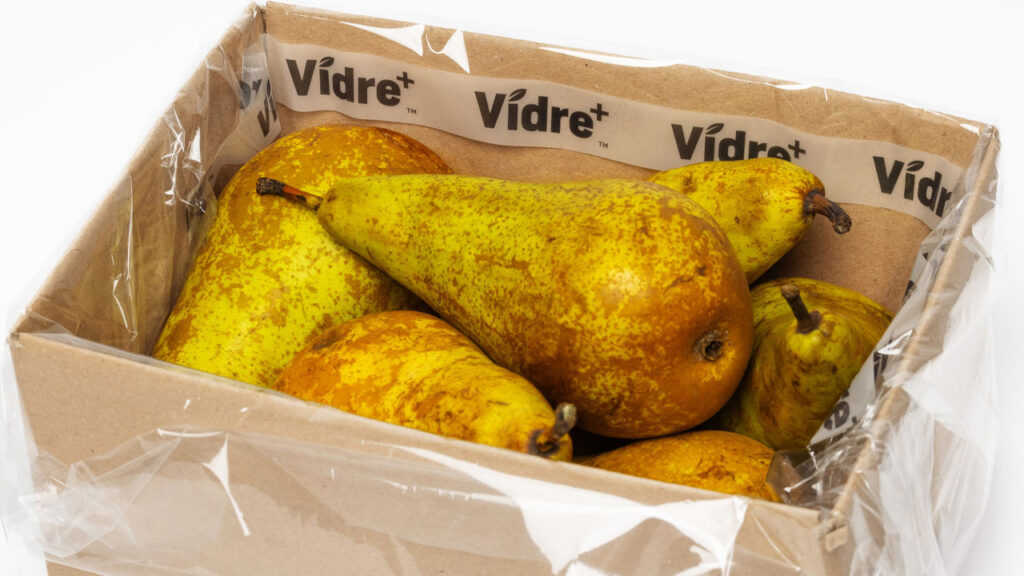
Fresh Inset’s Vidre+™ technology tackles a key driver of food waste: time. This solution slows the natural ageing of fruits, vegetables, and flowers by limiting ethylene activity inside the packaging. Applied via a simple self-adhesive label or directly integrated into packaging, Vidre+™ turns standard formats into smart, functional packaging with enhanced freshness. It requires no additional infrastructure, works with all packaging types, and fits easily into different stages of the postharvest supply chain—helping reduce preventable waste and create real operational value.
Key conclusions:
- Food waste costs the retail supply chain the equivalent of 33% of revenue, representing a USD 540 billion annual value opportunity if addressed.
- The global cost of food waste is projected to reach USD 3.4 trillion by 2030, with USD 94 billion lost annually in retail perishables alone.
- Food waste costs are rising, with 54% of industry leaders reporting increased losses over the past three years due to inflation and supply chain volatility.
- While 79% of industry leaders see technology as key to reducing food waste, large-scale implementation remains limited.
Disclaimer:
The data referenced in this press release is drawn from Making the Invisible Visible: Unlocking the Hidden Value of Food Waste to Drive Growth and Profitability, a global research report commissioned by Avery Dennison and published in 2025. The study was conducted in collaboration with the Centre for Economics and Business Research (CEBR) and is based on a global survey of approximately 5,500 food retail and supply chain leaders across seven markets, supported by economic modelling and industry case studies.
- For media inquiries please reach out to: media@peoplepr.pl
- For more information visit: WEBSITE & LinkedIn Page
- More Vidre+™ trials results can be found on the COMPANY BLOG:
About Fresh Inset
Fresh Inset S.A. (joint-stock company) is a food- tech from Toruń, Poland founded in 2017 by scientists from Synthex Technologies and developed by an international team that consists of a group of experienced scientists, agronomists, engineers, packaging sector experts, and IP lawyers around the globe, in such countries as the United States, Argentina, Brazil, Peru, and Poland. The company has developed and patented a unique Vidre+™ technology for extending the freshness of harvested fruit, vegetables, and flowers. The Company’s product has been patented in more than 50 countries. Fresh Inset is a member of the International Fresh Produce Association (IFPA) and Greentown Labs.
Vidre+™ is the breakthrough next-generation application of 1-MCP technology, which exponentially expands the benefits of produce preservation by mitigating the effects of ethylene. The research conducted on 5 continents proves that the technology works on various crops and varieties from avocados to grapes, limes, pears, tomatoes, peppers, and many more. Vidre+™ brings a timed and gradual release mechanism that allows produce to be treated by 1-MCP directly in packaging, eliminating the need for a 24-hour application in a sealed storage room or air-tight containers.
About Avery Dennison
Avery Dennison Corporation (NYSE: AVY) is a global materials science and digital identification solutions company. We are Making Possible™ products and solutions that help advance the industries we serve, providing branding and information solutions that optimize labor and supply chain efficiency, reduce waste and mitigate loss, advance sustainability, circularity and transparency and better connect brands and consumers. We design and develop labeling and functional materials, radio-frequency identification (RFID) inlays and tags, software applications that connect the physical and digital and offerings that enhance branded packaging and carry or display information that improves the customer experience. Serving industries worldwide — including home and personal care, apparel, general retail, e-commerce, logistics, food and grocery, pharmaceuticals and automotive — we employ approximately 35,000 employees in more than 50 countries. Our reported sales in 2025 were $8.9 billion. Learn more at www.averydennison.com.