
Produce Purchase Patterns Remained Disrupted in September
October 26, 2026 | 3 min to read
IFPA retail produce performance series shows produce purchase patterns remained disrupted in September.
Fuel prices climbed back to their May peak levels, prompting consumers to have to balance fuel and grocery budgets once more. This led to flat unit sales for total food and beverages combined with mild inflation-driven dollar growth. Produce also had its unique challenges, with continued double-digit declines in salads and leafy greens as shopping patterns have yet to recover to early-July trends.
Inflation Insights
Retail price growth in Circana’s MULO+ universe was stable at 2.2% in the third quarter and September 2026. While a few categories, such as the candy aisle, continued to post accelerated price growth, inflation rates have either slowed or held steady across most retail food and beverage categories. Premium choices, that also feed into higher prices, held as shoppers continued to prioritize quality and health
Price trends varied widely:
• Center-store prices reached an average of $4.17 per unit in September, up 3.5% year over year.
• The average unit price across all perishable departments was $4.40, up 0.8% versus September 2025.
• With beef starting to lap last year’s substantial price increases, overall meat department inflation moderated to just 0.7%, while prices of eggs, cheese and butter continued to come down.
Fresh produce prices deflated in September, especially for vegetables. The average price per pound for total vegetables dropped to $1.97, which was down 1.7% year over year. Fruit prices stayed within one percentage point from year-ago levels, with an average of $1.75. For both, prices fell below the annual averages.
Fresh Produce Sales
Fresh produce sales totaled $7.2 billion during the four September weeks, with fruit accounting for the largest share. Both fruit and vegetables lost ground in dollar sales, in part due to deflation and in part to due slightly lower demand. In the full-year view, dollar and volume sales are essentially flat year over year.
Total Store Comparison
Fresh produce sales far exceeded those of frozen and shelf-stable produce. However, frozen fruit and vegetables delivered strong growth across dollars, units, and volume. Both frozen fruit and vegetables experienced robust sales increases. Shelf-stable fruit and vegetables also had a positive month, with combined sales of more than $1 billion. Inflation helped boost dollar growth, but shelf-stable fruit, in particular, also enjoyed substantial demand-driven growth.
Top sellers
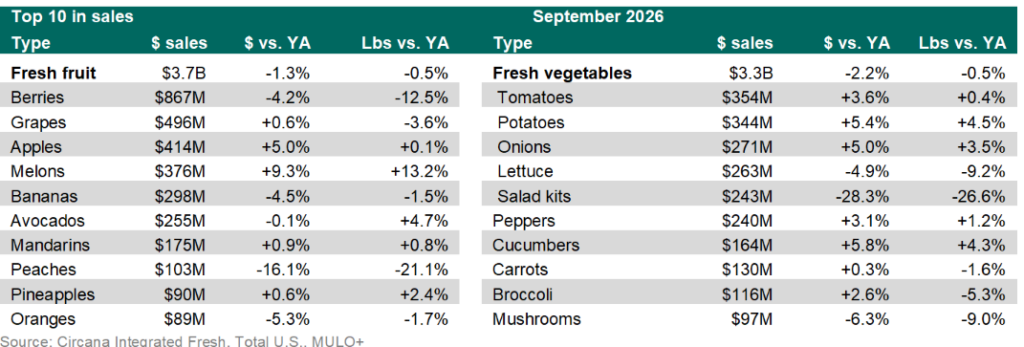
Importantly, overall dollar sales declines did not mean all commodities were down year on year. Grapes, apples, melons, mandarins and pineapples enjoyed dollar growth. Melons, avocados and pineapples had substantial increases in pound sales. On the vegetable side, tomatoes, potatoes and onions all enjoyed dollar and pound growth, but the 28.3% decline in salad kit sales pulled down the overall performance. Salad-adjacent vegetables, such as cucumbers, peppers and tomatoes did see renewed demand growth following a few subdued months.
Fresh Produce Absolute Dollar Gains
The top three commodities in absolute dollar growth added more than $75 million year over year with double-digit pound growth. Melons alone added $32 million and kiwis and sweet potatoes closed out the top three commodities. Neither kiwis nor sweet potatoes are big commodities but current social media trends combined with consumers seeking fiber and nutrient dense food led to 33.9% and 29.4% year-over-year pound growth, respectively.
While fruit dominated much of 2025 and the first quarter of 2026, vegetables represented seven out of the top 10 commodities, with sweet potatoes ranking highest.
Perishables Performance
September was a challenging month for the produce, deli and bakery departments. On the other hand, meat and seafood had a strong month with dollar, unit and volume gains.
The refrigerated department, which includes dairy, posted flat unit sales. However, sharp deflation in egg, butter and cheese prices pulled dollar sales below year-ago levels despite the increase in units.
Source: Circana, Integrated Fresh
— Anne-Marie Roerink, president, 210 Analytics