
ASC Marks Milestone Year of Growth, Innovation and Global Collaboration in 2025
December 11, 2025 | 7 min to read
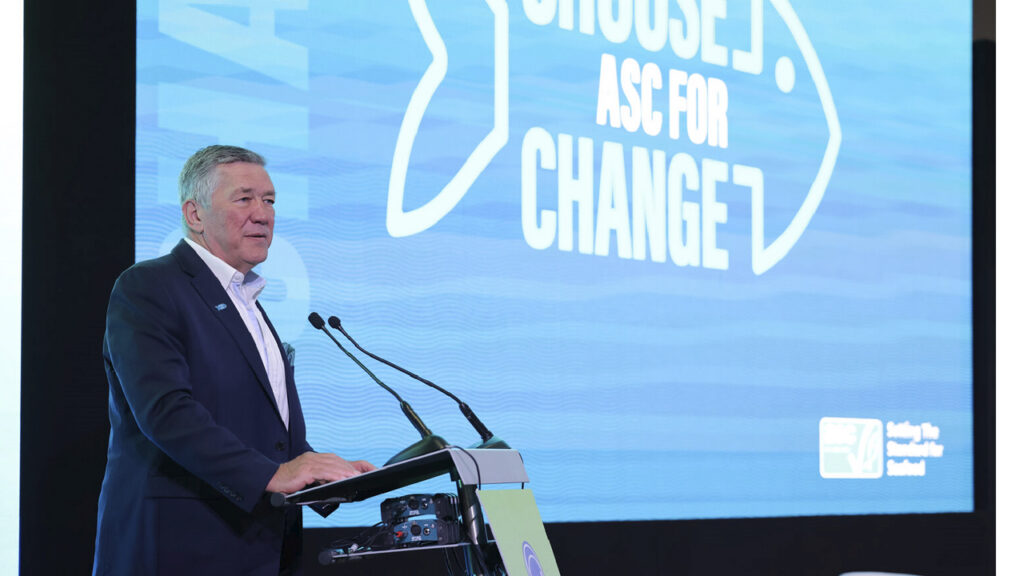
ASC marked a landmark year in 2025, advancing its certification programme, forging new partnerships and championing responsible aquaculture across global supply chains.
A major milestone was the launch of the ASC Farm Standard at Seafood Expo Global in May — the most significant development in ASC certification to date. The new Standard brings together ASC environmental, social and welfare requirements into a single, coherent framework, empowering stakeholders to prove the sustainability of their seafood through independently measured, verified and publicly available information. Throughout 2025, ASC supported producers and auditors in preparing for transition with tailored training, guidance materials, mock audits and direct engagement, helping ensure a smooth move to the new system.
Advancing The Leading Certification Programmes
ASC advanced animal welfare across the sector. The Farm Standard introduced comprehensive welfare requirements, while ASC contributed to key global forums to champion the link between strong welfare practices, farm performance and climate resilience. Regional teams worked with producers across Asia, Latin America, Africa and Europe to strengthen husbandry and biosecurity, reinforcing ASC’s role as a science-led leader.
ASC also strengthened its focus on human rights by advancing initiatives on worker voice, living wage, and community and Indigenous rights through targeted research, new training tools, and funded projects in key seafood-producing regions. At the same time, ASC began revising its Chain of Custody module with a stronger human rights focus, developing proposals that will be shared for public consultation in 2026.
ASC continued to transform aquaculture “from the feed up”. The Feed Certification Programme grew its global reach while addressing deforestation, land conversion, overfishing and forced labour. On 31 October, a major milestone came into effect: ASC-certified farms must now use ASC-conforming feed from ASC-certified mills, strengthening integrity and transparency across supply chains. The programme advanced efforts and expanded its global reach with 72 ASC-certified feed mills across 29 countries – as of 9 December 2025.
Programme expansion gained momentum, with the introduction of Atlantic Cod under the revised ASC Salmon and Cod Standard v1.5 and progress towards incorporating multiple catfish species into certification. The Improver Programme by ASC also grew, with 20 Aquaculture Improvement Projects active across six countries and strengthened capacity building for regional implementers.
Partnering To Increase Demand For Sustainable Seafood
Partnerships remained central to progress in 2025. ASC signed an MoU with South Korea’s National Institute of Fisheries Science to advance responsible aquaculture innovation, collaborated with Labeyrie Fine Foods and Omarsa on a mangrove restoration initiative in Ecuador, and worked with the Chamber of Aquaculture Ghana to develop a national Code of Good Practice. ASC also continued its partnership with Sustainable Fisheries Partnership on a roadmap for landscape-level improvements in the Indian shrimp sector.
ASC continued to expand its global and local marketing efforts by partnering with retailers, foodservice operators, and industry stakeholders to drive consumer demand and strengthen recognition of the value behind the ASC label. Through a series of collaborative activations across regions, ASC increased its presence in North America by launching joint restaurant promotions, media tours and consumer campaigns, delivered the ‘Check Your Fish’ campaign in Europe with retail and supply chain partners, and partnered with local organisations to activate Sustainable Seafood Week in Japan. Responsible aquaculture was further celebrated through ASC-hosted and partner-supported award events, including the Sustainable Seafood Awards in Australia, the inaugural Nordic Awards held in Sweden, and the ASC–MSC Awards in the United Kingdom and Germany. In Southern Europe, growing retailer partnerships have translated into increased availability of ASC-labelled products, including certified seabass, trout, and salmon, helping to convert awareness into tangible consumer choice.
Championing Innovation Through Industry Collaborations
ASC presence at global events continued to grow, with teams participating in 62 key industry gatherings. ASC experts contributed to 30 events and spoke at 31, championing the case for responsible aquaculture and elevating ASC leadership worldwide. Discovery Tours in Norway and Scotland also continued to give buyers first-hand insight into ASC-certified salmon farming.
One key event where ASC played a leading role was the Global Shrimp Forum, where ASC shared insights on the TraceASC digital traceability project and how it helps producers and farmers cut paperwork, verify sustainability, and access new markets.
Digital innovation strengthened assurance, with the launch of the Programme Centre — a new hub for navigating ASC Standards — and the Online Farm Mapping Tool, which improved data accuracy and streamlined audit preparation.
ASC CEO Chris Ninnes said, “ASC has made real strides this year. We have advanced our programme, partnered with leaders across the sector and championed responsible aquaculture on the world stage. I am deeply grateful to our dedicated teams and the producers, feed mills, retailers, auditors and partners who make our progress possible. As we move into 2026, we are energised by the opportunities ahead to strengthen our impact and help responsibly farmed seafood become the natural choice for everyone.”