
Prognosfruit 2025: EU Apple Production Holds Steady, Pear Output Grows Slightly Amid Market Uncertainty and Policy Challenges
August 7, 2025 | 4 min to read
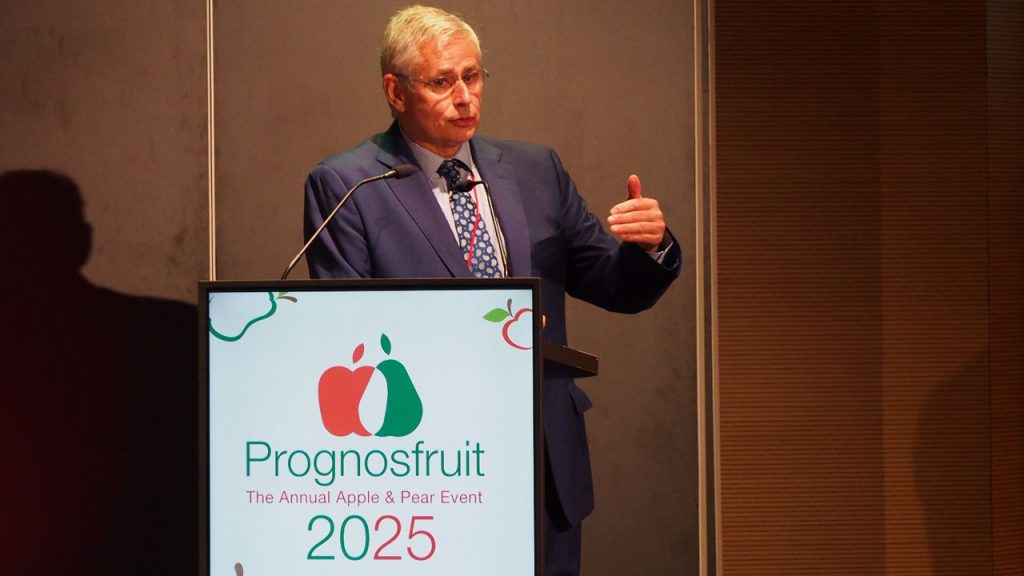
Angers, France – At the Prognosfruit Conference in Angers, the World Apple and Pear Association (WAPA) unveiled its highly anticipated forecast for the 2025/2026 season. The annual event, co-organized with the Association Nationale Pommes Poires (ANPP), is Europe’s leading forum for the apple and pear sector, attracting industry leaders from across the EU and its neighborhood as well as delegates from the USA, China, and the Southern Hemisphere. The conference discussed the outlook for the new season and the future of the sector.
At the Prognosfruit 2025 Conference, WAPA released its annual forecast for the 2025/2026 season. Apple production across the EU’s top producing countries is expected to remain nearly identical to last year’s volumes, reaching 10.5 million t (-0.1%), though remaining 7.5% below the 3- and 5-year average. Golden Delicious, as the main variety of the apple category, will see a minor decrease (-0.9% to 2.06 million t), while Gala stabilizes at 1.43 million t. Red Delicious and Idared are forecast to experience notable drops of -19.2% and -8.8% respectively.
On the pear side, EU production is projected to grow by 1.4% year-on-year to 1.79 million t, though it remains 2.5% below the 3-year average. Italy’s output is expected to fall again sharply (-24.7%), offset by substantial increases in Belgium (+32.1%) and the Netherlands (+8.1%). Conference pears will rise by +15.6% to 857,368 t, while William BC production will shrink by -16.7%.
For both apples and pears, the lower production compared to the previous years’ average reflects ongoing challenges in yield consistency, impacted by climatic havoc, the limited toolbox, the varietal transition towards better but less productive varieties, or the shift to organic.
A Season Shaping Up for Market Balance While Risks Persist
This year’s stable EU crop suggests a promising outlook for a balanced market — covering local demand, intra-EU trade, processing and export opportunities. While the U.S. and India are forecasting slightly higher crops, production in China and EU neighbourhood regions like Turkey, Serbia, Moldova, and Ukraine is expected to drop, potentially shifting market dynamics across the Middle East, Central Asia, India, and Southeast Asia.
Philippe Binard, Secretary General of WAPA, commented: “Despite a steady production forecast, the sector faces worrying uncertainties. Climate variability, a limited toolbox to manage biosecurity threats, labour shortage, rising costs not totally offset by market price, geopolitical instability, a volatile trade environment, and currency fluctuation are conditions that are clouding long-term visibility. A stronger European Union with a robust Single Market based on common rules is essential, especially as political trends move towards greater subsidiarity — which risks undermining competitiveness and distorting competition between EU growers.”
An Apple and Pear Sector Calling for Stability, Investment, and Clear & Coherent Policy Support
The Prognosfruit conference was an opportunity for industry leaders to reiterate that predictability and stability are critical to maintaining the EU fruit sector’s competitiveness and attractiveness for investment. As the EU continues to shape the future of its Common Agricultural Policy (CAP), apple and pear growers are increasingly concerned about proposed budget cuts for the upcoming EU Multi-Financial Framework 2028-2034 and the decentralisation of core responsibilities towards more subsidiarity granted to Member States, dismantling the basic principles of a common agricultural policy. These shifts could hinder the ability of European apple and pear growers to tackle shared challenges efficiently.
Luc Vanoirbeek, Chair of the Fruit and Vegetables Working Party at COPA-COGECA, emphasised: “Simplification and competitiveness could be fostered in many ways — from reducing red tape to harmonising tools like environmental footprint assessments and moving toward pan-European authorisation of plant protection substances. These steps are essential to support growers. There will be no food without agriculture. Policymakers must recognise that fruit and vegetables, including apples and pears, are central to their ambition to reach food security, improve food sovereignty, respond to sustainability and climate challenges, improve rural livelihoods, and deliver top nutritional value with minimal environmental impact.”
Apples and Pears: Strategic Crops for Europe’s Future
With a combined business value of over €10 billion, apples and pears are not only key economic drivers but also essential to environmental and social sustainability. At Prognosfruit 2025, the sector renewed its call for policy clarity, access to modern agricultural tools, and an end to the negative discourse around the responsible use of plant protection products. To ensure future success, industry leaders urged EU institutions to help create a coherent and business-friendly environment to stimulate consumption and maintain the sector’s strength in both domestic and international markets.
Daniel Sauvaitre, President of ANPP, concluded: “We are pleased to have hosted the 50th edition of Prognosfruit in Angers this year. The event is taking place at a pivotal moment for the future of the apples and pears sector. In times of global uncertainties, European apple and pear growers need more visibility and more Europe. The reinforced move towards more subsidiarity is in opposition and incoherent with the ambition of European decision markets for more simplification and competitiveness. Common rules for packaging, for plant protection products authorisation, or export protocols are basic principles that could solve many of the current concerns on competitiveness and confidence that are today in jeopardy.” Growers in Europe and around the world all face the same challenges. The gathering of Prognosfruit in Angers, which assembled more than 230 representatives from 23 nations around the world, allowed a very constructive, and positive exchange among European apples and pears leaders, with key representatives from the EU neighbourhood (UK, Turkey, Serbia, Moldova, Ukraine) as well as China, United States, and the Southern Hemisphere.
Prognosfruit’s journey will continue on 5-7 August 2026 in Germany, with a milestone for the event, celebrating 50 years of uninterrupted editions of Prognosfruit.
For general information about Prognosfruit, please contact WAPA at wapa@wapa-association.org.
WAPA was founded in August 2001 with the objectives of providing a forum for discussion on matters of interest to the apple and pear business and initiating recommendations to strengthen the sector. The current President of the Association is Jeff Correa (Pear Bureau Northwest – USA) and the current Vice-President is Nick Dicey (Hortgro – South Africa). WAPA membership includes the following countries and areas: Argentina, Australia, Austria, Belgium, Brazil, Chile, China, France, Germany, Hungary, Italy, Moldova, the Netherlands, New Zealand, Poland, Scandinavia, Slovenia, South Africa, Ukraine, the UK, and the USA.