
Protein PACT Partners’ Achievements, Resources for Further Success
October 22, 2025 | 4 min to read
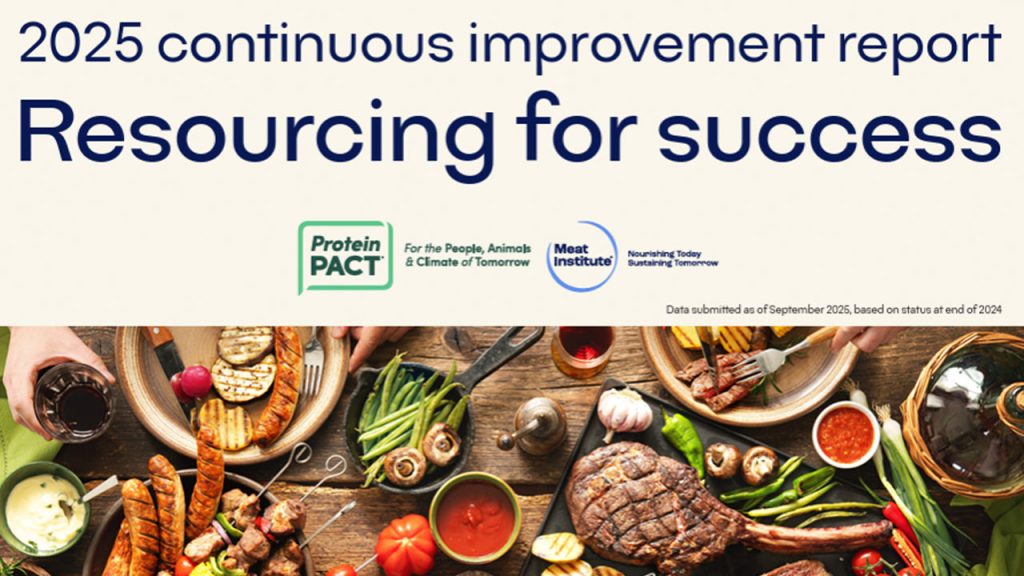
WASHINGTON, DC – The Meat Institute’s fourth annual continuous improvement report released at the Protein PACT Summit demonstrates progress on ambitious sustainability goals and provides updates on tools and partnerships accelerating achievement throughout the supply chain.
The report reflects data from companies representing the majority of meat sold in the United States, and for the first time includes data from member companies of the Canadian Meat Council. 81% of the Meat Institute’s largest member companies (more than 1000 employees) submitted data, including 100% the Meat Institute’s Executive Board members. In addition, the Meat Institute’s metrics and goals align closely with on-farm efforts in beef, pork, poultry and feed to drive supply chain-wide sustainability.
Meat Institute President and CEO Julie Anna Potts Commented:
“The Meat Institute created meat first-ever sector-wide data framework, and reliable, transparent data are the foundation on which our continuous improvement journey rests.
But data alone is not enough. Continuous improvement is, by definition, an ongoing and long-term commitment. It requires collaboration, accountability, and investment to ensure we can maintain momentum year after year. This year’s report elaborates on the many ways the entire animal agriculture community is advancing our shared commitment to sustaining nutrient-dense animal-source foods for generations to come.”
Key indicators and initiatives reflected in the report include:
- Examples of Protein PACT partners’ animal care initiatives, such as through Beef Quality Assurance®, Pork Quality Assurance Plus®, and U.S. dairy’s FARM Animal Care Program.
- Meat Institute data show 92% of reporting establishments that handle live animals have a comprehensive animal welfare program based on the Meat Institute’s Animal Handling Guidelines, and 92% pass third-party animal handling audits, at minimum annually.
- Examples of Protein PACT partners’ food safety initiatives and achievements. For example, according to the 2025 We Care® Sustainability Report, all fresh pork produced annually can be traced from retail or foodservice locations back to the packing plant or farm.
- Federal data on worker safety, showing workplace safety incidents continue their overall pattern of decades-long declines.
- Meat Institute resources supporting further achievements in worker safety include launching resources for “Worker Safety Topics of the Month” and partnering with the National Cattlemen’s Beef Association, as a contractor to the Beef Quality Assurance program, to launch updated worker safety training and education videos featuring best practices for individuals working with cattle in feedlots and in packer/processor facilities. The Meat Institute is also working with partners to expand best practice training resources to pork.
- Examples of contributions to supporting communities and ending hunger. 82% of reporting companies make donations to food banks and/or other charities. Meat Institute members and partners across animal agriculture donate tens of millions of dollars and meals to food banks, scholarship funds, and other charities across the country every year.
- Examples of Protein PACT partners’ initiatives to optimize contributions to healthy land, water, and air. 40 Meat Institute member companies have participated in emissions measurement, disclosure, and abatement training via Suppliers Leading on Climate Transition, building on the Meat Institute’s development of a practical tool to help meat companies conduct emissions surveys.
The Meat Institute’s full 2025 continuous improvement report is available here and a summary available here.
About the Meat Institute
The Meat Institute is the United States’ oldest and largest trade association representing packers and processors of beef, pork, lamb, veal, turkey, and processed meat products. Meat Institute members include over 350 meat packing and processing companies, the majority of which have fewer than 100 employees, and account for over 95 percent of the United States’ output of meat and 70 percent of turkey production. To learn more, visit MeatInstitute.org.
About the Protein PACT
The Protein PACT unites partners across animal protein to accelerate the entire sector’s progress toward global sustainable development goals for healthy people, healthy animals, healthy communities, and a healthy environment. Protein PACT partners are establishing transparent baselines and benchmarks, setting ambitious targets for continuous improvement, collecting data to verify and transparently report on progress, and launching comprehensive communications about animal protein’s unique place in healthy diets and sustainable food systems. To learn more, visit www.TheProteinPACT.org.